
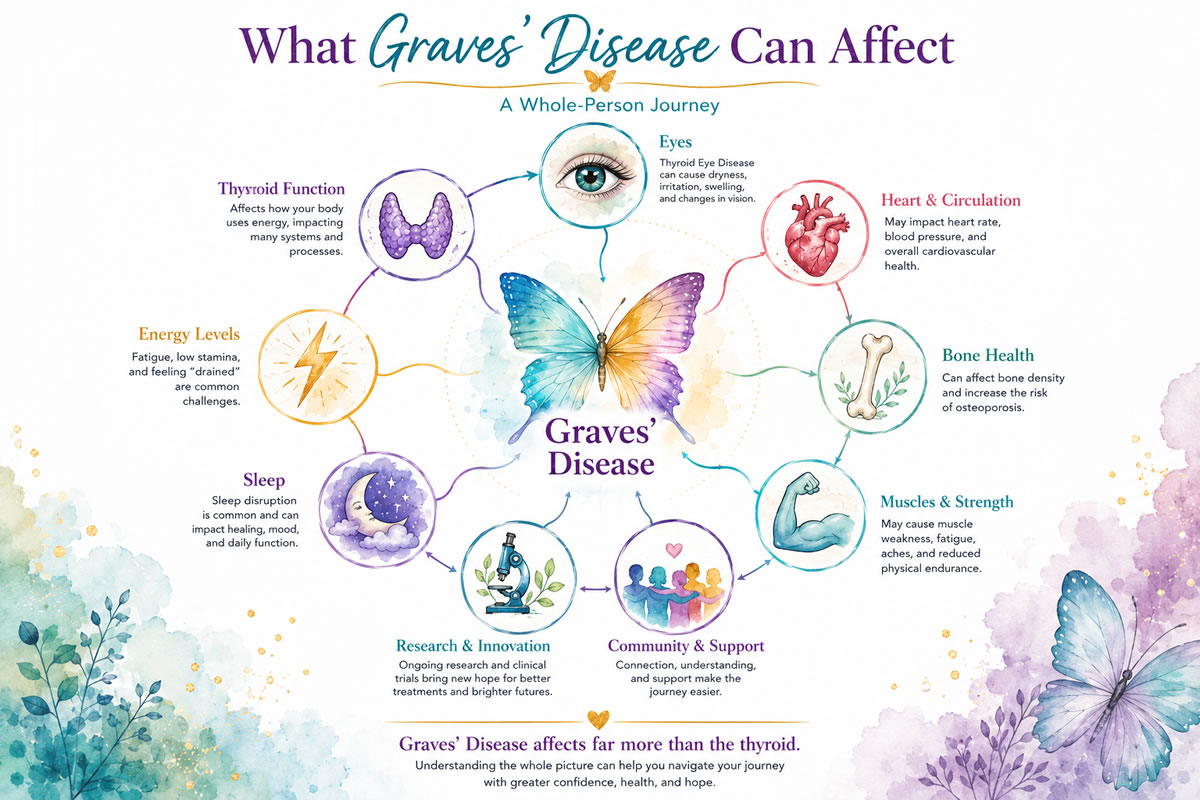
Graves’ Disease affects far more than the thyroid. It can impact the eyes, bones, heart, muscles, emotions, and many aspects of daily life.

Yet many people face this journey feeling confused, isolated, and without the support they need.

Graves’ Community was created to provide trusted education, meaningful connection, and hope. Whether you are newly diagnosed, living with Thyroid Eye Disease (TED), researching treatment options, or seeking ways to improve your health and wellbeing, you belong here.

Explore the topics that matter most to your Graves’ Disease journey.

woman walking through forest illustrating graves' disease autoimmune thyroid disease

Understanding Graves

Symptoms, diagnosis, treatment options, and common myths.

woman smiling as she comes through to the otherside of TED and Graves. The butterfly watercolor is the hope and promise of the Graves' and TED Community.

Graves’ & TED

Understanding the connection between Graves’ Disease & TED.

man and woman walking their dog in neighborhood - bone healthy activity for someone with graves' disease

Whole Person Care

Caring for your health, wellbeing, and the future you.

TED Community Builders in New York

Community & Support

Support groups, storytelling, creative programs, and events.

Hope on the Horizon

For decades, treatment options for Graves’ Disease remained largely unchanged. Today, researchers are developing therapies designed to target the autoimmune processes that drive Graves’ Disease.

Clinical trials are helping scientists better understand the disease and evaluate new approaches that may improve outcomes for patients in the future.

Whether you are interested in learning about emerging therapies, following research developments, or exploring participation opportunities, staying informed can help you make empowered decisions about your health.

graves' disease research and clinical trials with woman in field of flowers experiencing hope
graves' disease journey what it can affect including thyroid eye disease

Connect to Graves’ Community

Receive updates on:

✓ Graves’ Disease education

✓ Research & clinical trials

✓ TED & Graves’ resources

✓ Support groups

✓ Community events

Frequently Asked Questions About Graves’ Disease

Whether you are newly diagnosed or have been living with Graves’ Disease for years, questions are a natural part of the journey. Here are answers to some of the most common questions we hear from patients, family members, and care partners.
Yes. Graves’ Disease is an autoimmune condition, which means the immune system mistakenly attacks healthy tissue in the body. In Graves’ Disease, the immune system produces antibodies that stimulate the thyroid gland, causing it to become overactive and produce excess thyroid hormone. This can affect many aspects of health, including energy levels, heart rate, sleep, mood, muscles, bones, and overall wellbeing.

Because Graves’ Disease is an autoimmune condition—not simply a thyroid disorder—it can affect more than just the thyroid gland. Understanding the autoimmune nature of Graves’ Disease can help patients better understand their symptoms, treatment options, and the connection to related conditions such as Thyroid Eye Disease (TED).

Graves’ Disease is an autoimmune condition in which the immune system mistakenly attacks the thyroid gland, causing it to become overactive (hyperthyroidism). Because thyroid hormones affect many parts of the body, Graves’ Disease can impact energy, sleep, mood, heart rate, bones, muscles, and overall wellbeing.

No. Graves’ Disease and Thyroid Eye Disease (TED) are related but separate autoimmune conditions. Many people with TED also have Graves’ Disease, but treating one condition does not necessarily treat the other.
Yes. Graves’ Disease can affect many parts of the body, including the eyes, heart, bones, muscles, sleep, energy levels, and emotional wellbeing. This is why a whole-person approach to care is so important.
Graves’ Disease is considered a chronic autoimmune condition, but every person’s journey is different. Some people achieve long periods of remission, while others require ongoing monitoring and treatment. Working closely with your healthcare team can help you find the approach that is right for you.
Treatment options may include antithyroid medications, radioactive iodine (RAI), thyroidectomy (surgical removal of the thyroid), and emerging investigational therapies currently being studied in clinical trials. The best option depends on your individual situation.
Yes. For the first time in history, researchers are developing therapies designed to target the autoimmune mechanisms that drive Graves’ Disease. Clinical trials are underway, and many patients are hopeful that these advances will lead to new treatment options in the years ahead.

Yes. While lifestyle choices do not replace medical care, many people find that healthy habits can support their overall wellbeing and help them better navigate life with Graves’ Disease. Areas that may play an important role include nutrition, physical activity, sleep, stress management, emotional support, and avoiding smoking.

Because Graves’ Disease affects the whole person—not just the thyroid—small, consistent choices that support physical and emotional health can make a meaningful difference over time. Every person’s journey is unique, so it is important to work with your healthcare team to determine what approaches are right for you.

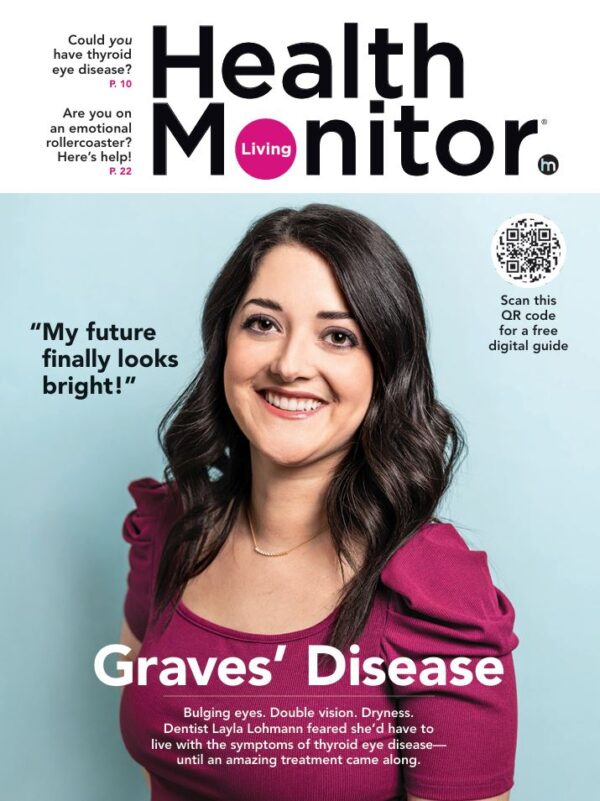
health monitor magazine features Graves' Disease on the cover - read the full article

Click Magazine Cover: Read about Graves'

With Appreciation for our Partners & Membership Organizations
through TED Community 501(c)(3) Nonprofit

Amgen Rare Disease formerly Horizon Therapeutics
Argenx - Reaching Patients Through Immunology Innovation
Viridian Therapeutics
Genentech
Kriya Gene Therapy Redefined
Sling Therapeutics’ convenient oral small molecule linsitinib is in a Phase 2b trial for thyroid eye disease (TED).
Prevent Blindness
Global Genes
National Organization of Rare Disorders
Thyroid Federation International